Thursday, November 13, 2025
Author: Ochieng Pelecia Anyango
Category: Welfare, Food, Inflation
⏱️ Estimated Read Time: 5 min read
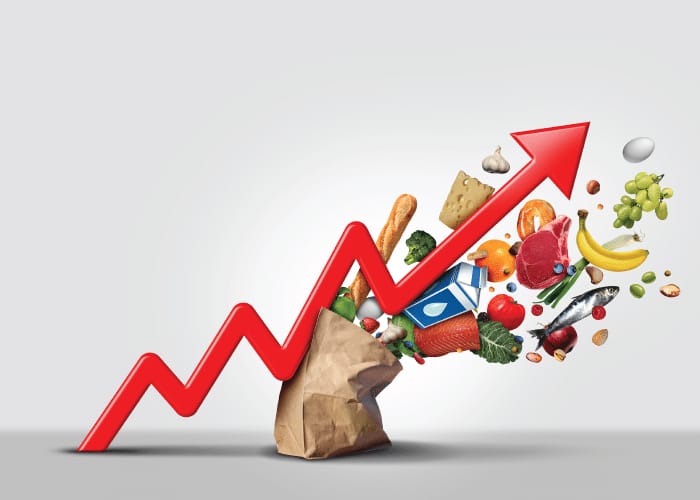
Essentials like food are becoming more expensive due to rising prices and stagnant wages. For low-income urban households, this translates into a deeper strain on already tight budgets. As prices rise, purchasing power weakens, forcing families to spend a larger share of their income on basic needs, leaving little room for savings or upward mobility. These effects carry both economic and social consequences, underscoring the need for better policies to contain food inflation spikes.
Kenya’s overall annual inflation rate stood at 4.6 per cent as of October 2025. Food inflation grew by 0.2 per cent in October compared to September and by 8 per cent year-on-year, reflecting higher costs of everyday food items. Food prices mainly drove this, while most non-food items recorded only slight changes.
As shown in Table 1, inflation trends for October 2025 indicate that price pressures were largely concentrated in food items. Transport costs increased slightly, while the housing and energy sector showed some relief as electricity, kerosene, and LPG prices fell. Clothing, footwear, and alcoholic beverages recorded mild price increases linked to steady demand and higher production costs.
Table 1: Monthly and Annual Changes in Kenya’s Consumer Price Index (CPI)
| COICOP Divisions | Weight % | %Change on last month (October 2025/September 2025) | %Change on the same month of the previous year (October 2025/October 2024) |
| Food and Non-Alcoholic Beverages | 32.9094 | 0.2 | 8.0 |
| Alcoholic Beverages, Tobacco, and Narcotics | 3.3289 | 0.1 | 3.1 |
| Clothing and Footwear | 2.9914 | 0.1 | 2.9 |
| Housing, Water, Electricity, Gas, and Other Fuels | 14.6124 | 0.3 | 1.9 |
Furnishings, Household Equipment, and Routine Household Maintenance | 3.7372 | 0.0 | 1.7 |
| Health | 2.9116 | 0.1 | 2.8 |
| Transport | 9.6468 | 0.4 | 4.8 |
| Information technology | 7.7840 | 0.0 | 0.7 |
| Recreation, Sport and Culture | 1.7219 | 0.2 | 2.7 |
| Education service | 5.5620 | 0.0 | 2.2 |
| Restaurants and Accommodation Services | 8.0991 | 0.4 | 2.3 |
| Insurance and financial services | 2.2423 | 0.0 | 0.8 |
Personal Care, Social Protection, and Miscellaneous Goods and Services | 4.4532 | 0.1 | 2.7 |
| TOTAL | 100.0000 | 0.2 | 4.6 |
Source: Author’s compilation from the KNBS Consumer Price Index and Inflation Report, 2025.
According to the Economic Survey 2025, inflation has been particularly persistent in food and non-alcoholic beverages, with some staple items rising by over 20% in just two to three years. As corroborated by Ocholla from IEA, Kenya's rising prices are significantly impacting vulnerable families by reducing their purchasing power and deepening economic insecurity, leaving many struggling to cover basic needs such as food and housing.
Figure 1 shows a general upward trend in food commodity prices from October 2024 to October 2025. Staple foods like Sukuma wiki, maize grain, and tomatoes saw double-digit increases, with Sukuma wiki rising nearly 16%. Between September and October 2025, sugar, maize grain, and Sukuma wiki—core items for low-income families—rose by 4.3%, 2.8%, and 3.5%, further eroding purchasing power.
Faster price growth was observed for sugar, onions, and tomatoes, likely driven by supply constraints such as import restrictions and seasonal factors. Meanwhile, sifted and fortified maize flour showed modest increases, and fruits such as oranges and mangoes recorded minimal or negative changes, possibly due to better harvests. Overall, the data highlights persistent inflationary pressure on essential food items, particularly vegetables and sugar.
Figure 1: Average Retail Prices and Per cent Changes of Selected Food Commodities.

Source: Author’s design based on the KNBS Consumer Price Index and Inflation Report, 2025.
As food prices rise faster than wages, these households experience a sharp decline in real purchasing power, leading to food substitution or, in extreme cases, starvation. The shift worsens malnutrition, especially among children. Moreover, high food inflation often leads to increased borrowing or depletion of meagre savings, trapping households in a cycle of poverty and economic vulnerability.
Socially, persistent high food inflation fuels inequality, erodes social cohesion, and can even trigger unrest. When low-income families struggle to afford daily meals, tensions rise as disparities between the rich and poor become more visible. Communities may experience increased crime rates as desperation drives some individuals to seek alternative, often unlawful, means of survival. In extreme cases, governments face public protests and political instability, as seen historically in several developing nations. Thus, unchecked food inflation may also threaten the very fabric of social stability for any given state.
In conclusion, as shown in the data and illustrations, food inflation in Kenya continues to strain the daily lives of many households. The rising cost of essential items such as food, housing, and transport has made it increasingly difficult for low-income families to meet their basic needs, underscoring the need for targeted fiscal interventions to protect the most vulnerable. While Kenyans have shown remarkable resilience, true progress will depend on consistent efforts to stabilise prices, strengthen local food production, and cushion vulnerable groups from future economic shocks.
To address food inflation sustainably, Kenya must move beyond reactive measures and adopt a multi-dimensional strategy rooted in Amartya Sen’s entitlement theory. First, the government should strengthen transfer-based entitlements by investing in a robust social protection mechanism through cash transfers to the vulnerable. This will ensure the ability to buy and protect vulnerable households during tough times. Secondly, boosting production-based entitlements is essential. Supporting local agriculture through innovation, agro-processing, and small-scale farmer empowerment will stabilise prices. Improving labour-based entitlements means enabling farmers to convert their work into reliable food access. This requires better access to inputs, irrigation, credit, and fair markets. Finally, trade entitlements can be reinforced through the withdrawal of the heinous high tariffs on food imports, as corroborated in the analysis of How Food Tariffs are starving Kenyans.
Based on these recommendations, tackling food inflation requires a multi-dimensional approach that combines sound policy, consumer empowerment, agricultural empowerment, and crisis preparedness. Only through coordinated action between the government, private sector, and citizens can Kenya ensure that households not only survive the surge but also emerge stronger and more resilient.